


By Wentland Muhatiah, Senior Advocacy and Policy Research Officer—ACCESS Coalition
A Life Lived in the Shadows
Picture this: it’s a humid night in rural Uganda. A mother, eight months pregnant, feels the first pangs of labor. The nearest clinic is ten kilometers away, and even when she gets there, the delivery room is lit by a single flickering kerosene lamp. The midwife fumbles for clean tools in the dim light, while the anxious father paces outside, praying that nothing goes wrong.
This isn’t history. It’s a reality for millions today. For millions across Sub-Saharan Africa, life is dictated by the absence of electricity. Children study under candles, farmers lose USD 4 billion annually due to post- harvests losses because they can’t refrigerate their produce. Hospitals turn away patients due to lack of power to run essential equipment. Nearly a billion people-majority of whom are women-lack access to clean cooking options and inhale toxic smoke daily as they majorly rely on wood-fuel for cooking.
And the cruel irony? The world has the technology, the knowledge, and resources to fix this. What we lack is urgency.
The latest SDG 7 Energy Progress Report (2025) is both a mirror and a warning. It reflects how far we’ve come and how much further we need to go. It warns that unless we act decisively, energy poverty will remain one of the greatest obstacles to Africa’s and by extension, the world’s development.
The Numbers Behind the Crisis
The SDG 7 report underscores both achievements and inequities:
- Electricity: Global access has risen to 92%, yet 666 million remain in the dark-85% in Sub-Saharan Africa. In Nigeria, Ethiopia, and the DRC alone, over 220 million lack power. Gains are being erased by population growth; for every 35 million who gain access, 30 million are born.
- Clean cooking: 2.1 billion still rely on wood, dung, or charcoal. By 2030, 1.8 billion may still be left behind, half in Africa-causing nearly 4 million premature deaths annually, mostly women and children.
- Renewables: They now make up 30% of global electricity use, but the world is still 3.8–4.2 terawatts short of the COP28 target.
- Efficiency: Progress is stuck at 1%-well below the 4% annual improvement needed.
- Finance: Achieving SDG 7 requires $4.5 trillion annually, yet the poorest states receive far less than needed.
Based on this latest data, the inequity is worrying: energy poverty is now concentrated in Africa.
Why Energy Access Matters ?
Energy access is the “golden thread” for sustainable development. Without it: Hospitals can barely operate; children can’t study at night; businesses can’t grow and worse, communities continue to be trapped in poverty.
Energy poverty traps people in cycles of disadvantage. But the reverse is also true: energy access unlocks progress across all SDGs: health, education, gender equality, economic growth, and climate action.
This is why the SDG 7 report is not just about kilowatts and statisctics. It is about the possibility of transforming lives at scale.
Why Africa Holds the Key?
Here’s the reality: the battle for energy access will be won or lost in Sub-Saharan Africa.
- In Asia, electrification is accelerating rapidly. India, Bangladesh, and Vietnam are nearing universal access.
- In Latin America, renewable deployment is booming.
- In Europe and North America, efficiency improvements are picking up speed.
But in Africa, the challenge remains vast. Eighteen of the top 20 electricity access deficit countries are African. Clean cooking access in rural Africa is as low as 7%. Renewable capacity per capita is just 40 watts, barely enough to charge a phone or power a single light bulb.
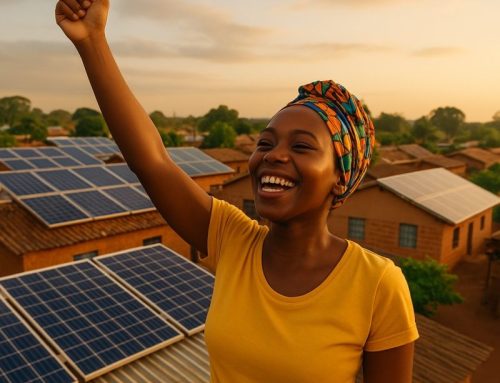
And yet, Africa holds the greatest potential. With abundant sun, wind, and young entrepreneurial talent, the continent could leapfrog into a decentralized, renewable-powered future. Off-grid solar, mini-grids, and clean cooking innovations are already proving that Africa can write a different story.
The question is not whether Africa can deliver-it’s whether the world will invest, innovate, and act fast enough to make it happen.

Leave A Comment