What Southeast Asia’s lights and kitchens can teach Africa about energy access
By Wentland Muhatiah, Senior Advocacy and Policy Research Officer, ACCESS Coalition
In 2000, roughly one in six people in Cambodia had electricity. So did roughly one in six people in Kenya. Both were poor, largely rural countries with weak grids and a long list of more urgent problems.
By 2024, 99% of Cambodians had electricity, and Kenya had reached 77%. Kenya’s progress is real, and faster than most of its neighbours. Still, the 22-point gap between the two countries is more than 12 million Kenyans waiting for a connection that most Cambodians now take for granted.
The gap shows up in the kitchen too. Most people in Thailand and Viet Nam now cook with clean fuels, mostly gas or electricity. In Kenya, about a third do. In Uganda and Malawi, World Bank estimates put the figure at about 2%.
In October, I was in Bangkok for the World Bank Group and IMF Annual Meetings, in a region that has largely solved problems Africa is still working on. I came away asking what Southeast Asia did, and what it means for Mission 300 and for the many African countries still working to reach every household.
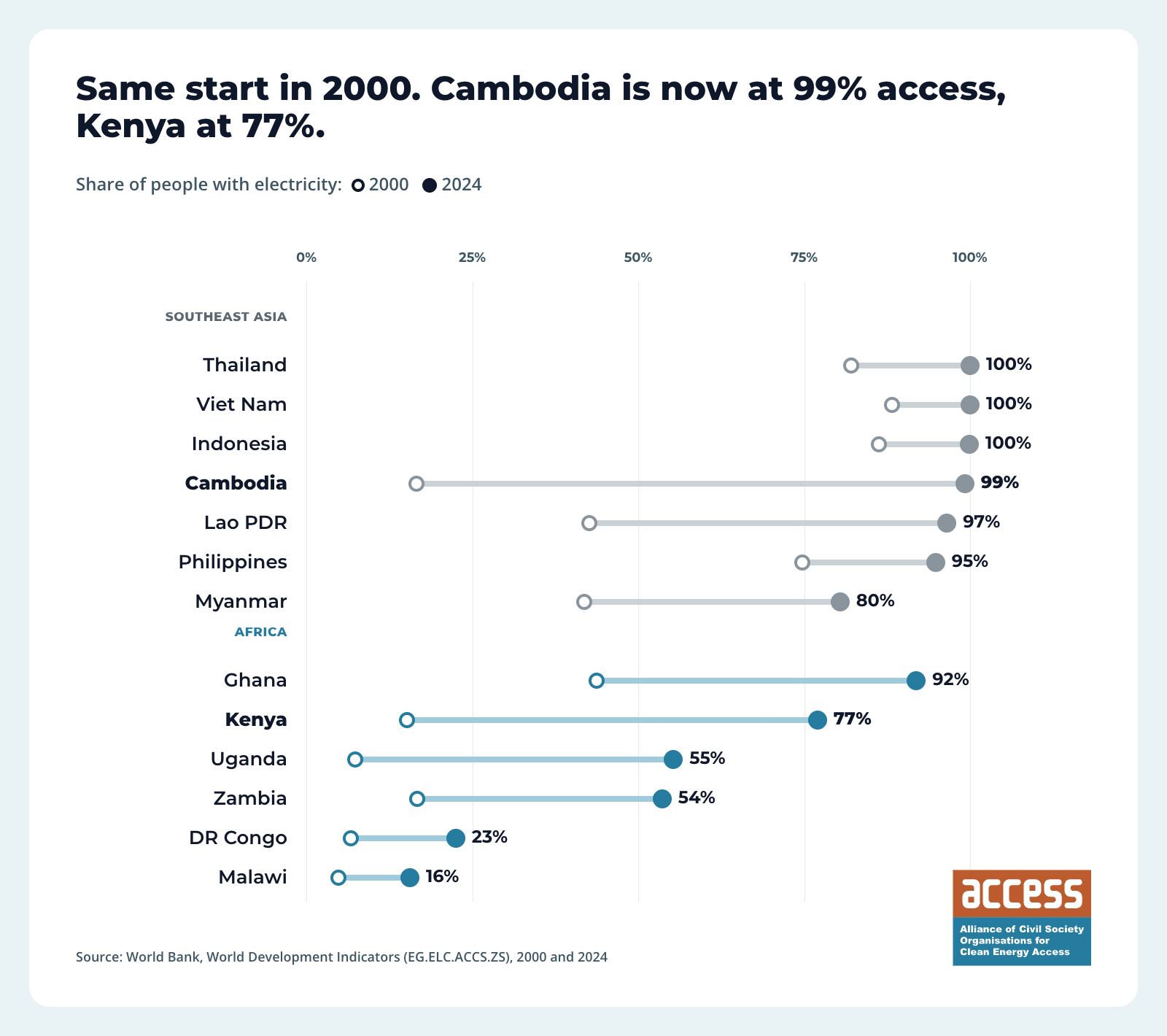
Source: World Bank, World Development Indicators, access to electricity (% of population), 2000 and 2024.
Two regions, a generation apart
Southeast Asia is now close to universal electricity access. Thailand and Viet Nam have reached 100%, and Indonesia stands at 99.9%. Lao PDR, a landlocked and mountainous country, went from 43% in 2000 to 97%. Even Myanmar, after years of conflict, is above 80%.
Sub-Saharan Africa is in a very different place. Of the roughly 655 million people in the world still without electricity, 563 million, about 86%, live in the region.
The spread within Africa is wide. Ghana has passed 90%, a success that deserves more attention than it gets. Kenya is at 77%. Uganda and Zambia have crossed the halfway mark. The Democratic Republic of the Congo (DRC) is at 23% and Malawi at 16%, which means more than eight in ten Malawians still live without electricity.
Wealth is only part of the story
The usual explanation is money. Southeast Asia grew richer, and richer countries electrify. That explains some of it. It does not explain Cambodia, which was among the poorest countries in Asia when its access took off in the early 2010s, or Lao PDR, whose rural households were as hard to reach as any in Zambia or Malawi.
What these countries shared was a set of decisions. Governments treated electrification as a national project with a deadline. Utilities were given a clear mandate and the resources to carry it out, and communities helped build and run local networks. And programmes did not stop at the village: when poor families could not afford the connection fee, governments found ways to spread the cost so that the poorest homes were connected too.
Where Africa has fallen short
Africa’s record is not one of failure. Ghana’s National Electrification Scheme and Kenya’s Last Mile Connectivity Programme have connected millions of people. Uganda’s access rate has nearly tripled since 2015.
Some patterns still need an honest look. Too much of our electrification has followed donor project cycles rather than long national plans. Utilities have been asked to extend the grid while being kept financially weak, so maintenance suffers first, and rural customers suffer with it. Connection fees have come down without the cost of using electricity coming down with them, leaving many newly connected households barely able to afford to switch on. And the countries furthest behind are the hardest to finance on ordinary terms: the DRC because of conflict and fragility, Malawi because of heavy debt.
Mission 300 is the best chance in a generation to change this. Its National Energy Compacts are long-term, government-led plans of the kind that worked in Southeast Asia. Whether they come with the rest of what worked there, from strong utilities to affordable connections and finance for the hardest places, is still an open question.
The kitchen gap
If the electricity gap between the two regions is wide, the cooking gap is wider. In Viet Nam, 91% of people cook with clean fuels and technologies. In Thailand, 88%. In Ghana the figure is 35%, in Kenya 32%, in Zambia 10%, in the DRC 5%, and in Uganda and Malawi 2%.
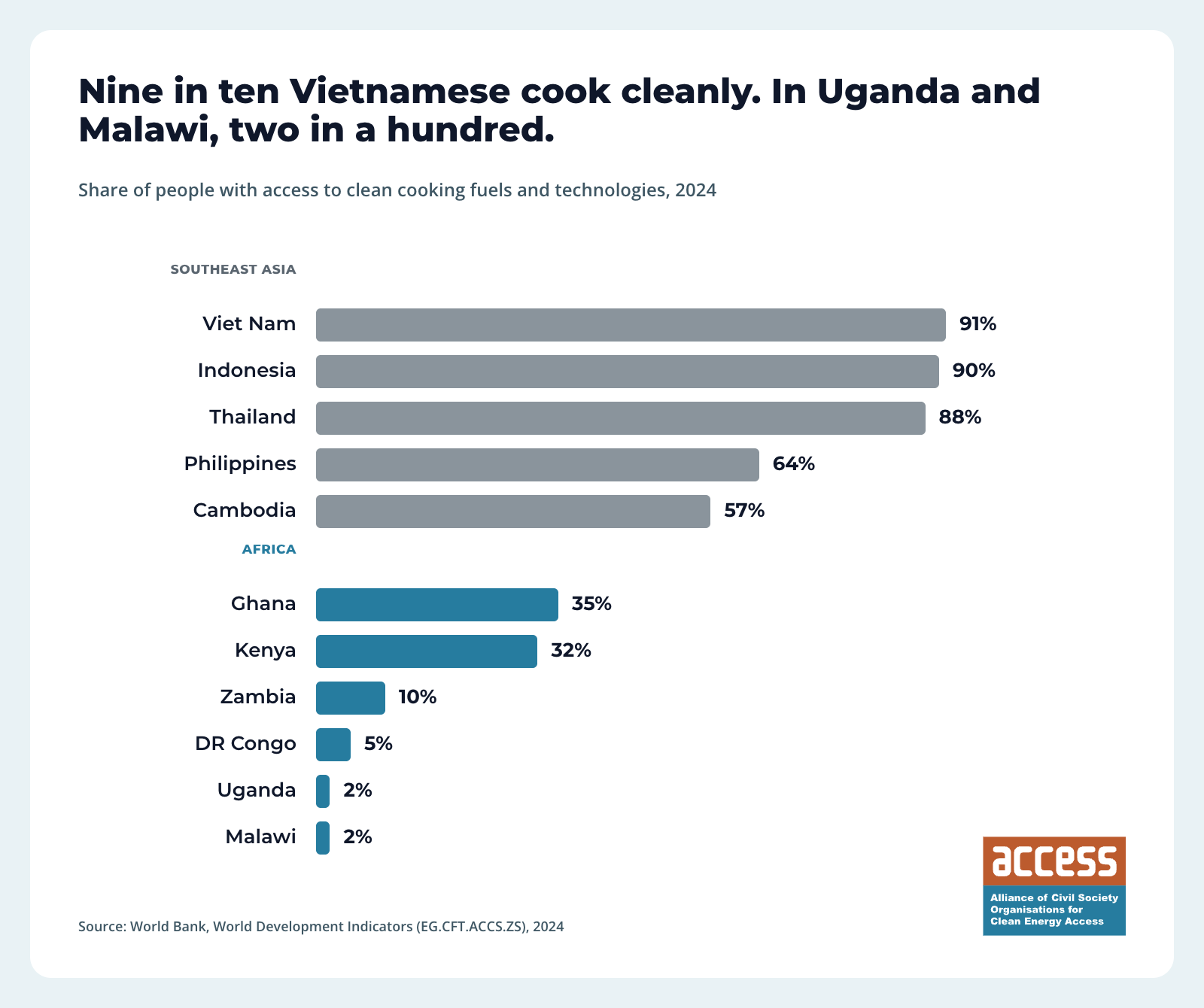
Source: World Bank, World Development Indicators, access to clean fuels and technologies for cooking (% of population), 2024.
Many African households already have power and still cook with charcoal or firewood. Ghana has electricity access above 90%, yet only about a third of Ghanaians cook cleanly. In Kenya, 77% of people have electricity and 32% cook cleanly. For millions of families, the wire is already in the house.
Around 2 billion people worldwide lack clean cooking, and about half of them live in Africa. The International Energy Agency estimates that universal access in Africa could be reached with about USD 4 billion a year, a small sum by the standards of energy finance. Africa can afford to solve this. What it has to decide is how.
How Southeast Asia cleaned up its kitchens
Most of the region did it with gas. Indonesia’s story is the most striking. In 2007, the government began moving households off subsidised kerosene and onto liquefied petroleum gas, handing out free conversion packages built around a small 3 kg cylinder. By 2009, around 23 million packages had gone out, and nearly 84% of Indonesian households now cook with LPG. Few countries have changed how people cook so quickly.
Thailand’s progress has also leaned heavily on LPG. In Viet Nam, electricity plays a bigger part than many people realise. A small 2017 survey of 60 urban households in the coastal city of Tuy Hoa found the electric rice cooker as common as the fan and the fridge, with about one home in three also owning an induction cooker.
Indonesia’s success has come with a growing bill. The country now imports most of its LPG. In 2023 it used about 8 million tonnes against domestic production of about 2 million, and the import bill came to around USD 4.8 billion. The subsidised cylinder also costs the budget trillions of rupiah a year, much of it going to households that do not need the help.
Indonesia is now looking at a second switch, from gas to electricity. In 2022 it tested induction stoves in Bali and Solo, with 2,000 units out of a planned 300,000, before putting the national rollout on hold. Research published by IISD in December 2025 found households in the pilots reporting cleaner kitchens and lower monthly costs. It estimated that better-targeted LPG subsidies, combined with support for induction cooking, could save the government IDR 7–12 trillion a year.
Indonesia’s experience holds a useful lesson for African countries. Where the power supply allows, going straight to electric cooking can reduce reliance on imported fuel and the subsidy bills that come with it, while cleaner fuels continue to play their part where it cannot.
Africa’s electric advantage
The evidence that electric cooking works in Africa is now strong. Data gathered by the Modern Energy Cooking Services programme (MECS) from cooking studies in countries including Kenya, Uganda, Tanzania and Zambia show that cooking a dish in an electric pressure cooker costs about a third as much as using LPG, and less than a fifth as much as using charcoal.
Ghana’s own research agrees. A 2023 study by the University of Ghana’s Institute of Statistical, Social and Economic Research found that a traditional ampesi meal cost GH¢2.37 to cook on charcoal and GH¢2 on LPG, compared with 61 pesewas in an electric pressure cooker. The electric appliances produced no carbon monoxide.
For a household with a reliable connection, the cheapest clean way to cook may already be plugged into the wall.
African countries start from very different places. Kenya and Ghana are best placed, with high electricity access and about a third of people already cooking cleanly. Kenya has gone furthest on policy, with a National Cooking Transition Strategy that aims for universal clean cooking by 2028 and a dedicated eCooking strategy. Its policy scenario sees at least half of households using LPG and about 10% using electricity as part of their mix of cooking fuels. Given the evidence on cost, there is a strong case for planning a larger role for electric cooking wherever supply is reliable.
Zambia has some of the cheapest electricity in the region, but the 2024 drought, which cut output from its hydropower-dependent grid, showed that nobody switches their dinner to a supply they cannot count on.
Uganda has expanded electricity access quickly, yet the kitchen has barely changed. Only about 1% of Ugandan households used electricity, LPG or biogas for cooking in the 2016 Demographic and Health Survey, and the 2024 census found that around 95% of Ugandans still depend on firewood and charcoal.
Malawi shows both the scale of the problem and a way through it. Nine in ten or more Malawian households cook with wood, charcoal or crop residues, and only 18% of the population lives in towns. Yet in 2022, in the four largest cities, Lilongwe, Blantyre, Mzuzu and Zomba, about 22% of households cook with electricity and 6% with LPG. Where the grid reaches, Malawian families are already choosing to cook with it.
In the DRC, where only about one person in five has electricity, electric cooking will spread first in towns and in institutions such as schools and hospitals. The same is true of rural Malawi. Improved cookstoves will matter in these places for years, and every new connection should still be planned with cooking in mind. Mini-grids and solar home systems sized for efficient cooking appliances can extend electric cooking to places the main grid will not reach for years.
The tariff decides the menu
The price of electricity decides more than anything else whether families cook with it. MECS offers a simple rule of thumb: the cost of cooking one dish electrically is roughly a tenth of the price of a kilowatt-hour. Halve the tariff and you roughly halve the cost of dinner.
Most tariffs in Sub-Saharan Africa were designed for light bulbs. Lifeline tariffs, the cheap first block of power meant to protect poor households, usually cover lighting, a phone and perhaps a radio. Cooking needs far more. Southeast Asia’s lifeline schemes show the same limit. Viet Nam charges a lower price for the first 50 kWh a month, and since 2008 Thai households using under 50 kWh a month have paid nothing at all. Both protect poor households, but neither was built for cooking. Thailand’s scheme also ended up subsidising better-off owners’ holiday homes, which use little power.
Uganda went further. In 2022 it introduced a tariff designed specifically for cooking. Households pay UGX 412 per kWh, instead of the usual UGX 756, for use between 81 and 150 kWh a month, and institutions with separately metered kitchens pay UGX 360. It was a bold move, but the share of Ugandan households cooking with electricity rose only from 1.4% to 1.7% in three years. The average household uses about 42 kWh a month, nowhere near the 80 kWh where the discount starts, and in one study 73% of families given electric pressure cookers did not know the tariff existed.
Kenya introduced a band for households using 30 to 100 kWh a month in April 2023, priced halfway between the lifeline and the standard rate. It arrived alongside price rises of 30–50% for all consumers, and analysis cited by MECS suggests that cooking every meal electrically in Kenya now costs slightly more than cooking with gas, a reminder that the cost advantage depends on the tariff. To our knowledge, Ghana, Malawi and the DRC have yet to introduce tariffs designed for cooking.
A good cooking tariff starts its discount where poor households actually are, nearer 50 kWh than 80. It covers a cooking-sized block of about 70 kWh. It begins with schools and hospitals, which cook at scale and can be metered separately. Its cost is shared with health and climate budgets so the utility stays solvent. And it is never launched alone, because a cheaper kilowatt-hour means little to a family that cannot afford the pot or has never heard of the discount.
What Mission 300 can take from Southeast Asia
For Sub-Saharan African governments and their Mission 300 partners, Southeast Asia’s experience comes down to six practical steps. They build on the five asks in ACCESS’s position paper, Powering People, Building Resilience: Making Mission 300 Count:
- Name a lead institution in each Mission 300 Compact, with a clear rural mandate and a budget to match.
- Make connections affordable to the poorest household in the village. Lao PDR’s Power to the Poor programme lent poor families their connection fee interest-free, so that the repayments and the electricity bill together cost no more than the kerosene and batteries they replaced. The same approach can work for electric pressure cookers.
- Ring-fence finance for the hardest places. As ACCESS proposes, at least 15% of Mission 300 finance should be reserved for fragile and conflict-affected contexts, with grants and concessional finance first.
- Plan and track cooking alongside connections. Mission 300 investments should build in electric cooking loads from the start, as ACCESS’s position paper recommends, and report how many connected households cook with electricity, not only how many have a meter.
- Design tariffs for kitchens, following the principles above.
- Put reliability first, because nobody cooks or runs a business on power that fails at dinner time. Where the grid will take years to arrive, invest in mini-grids and solar home systems, in line with ACCESS’s call to rebalance Mission 300 investment towards decentralised renewable energy.
The Global eCooking Coalition (GeCCo), backed by MECS, SEforALL, GEAPP and EnDev, aims to see at least ten countries move more than a tenth of their households and institutions to electric cooking by 2030. Several African countries are natural candidates, and ACCESS would welcome the chance to work with these partners and with governments to get there. Civil society has a meaningful role to play. Our members work in the communities where these decisions play out, and they bring grassroots experience of which households have been connected and still cook on charcoal, and why. Bringing that evidence into transition planning can help governments and partners decide where support is needed most.
Southeast Asia lit its villages and cleared most of the smoke from its kitchens within a generation. Africa can do both faster, with power it generates at home.